
The challenge
Some industries produce CO₂ by the very nature of their processes. The question is what happens to it.
Cement, steel, petrochemicals, and refineries form the backbone of the global economy, and their process-related CO₂ will persist for decades. In these hard-to-abate industries, CO₂ is not just a by-product of energy use, it is released directly by the chemical reactions at the heart of production. Carbon capture, utilization, and storage (CCUS) closes this gap.
We provide the compression technology that makes it possible to capture CO₂ at the source, compress it for transport, store it safely underground and use it as raw material for synthetic fuels, chemicals, and building materials.
The CCUS process
How carbon capture works – from source to storage
Capture
CO₂ is captured directly at the source. We stay technology-agnostic here: our compression solution integrates with every established capture process, so the method that fits your plant also fits our system.
Compress
This is where we come in. Our integrally geared compressors bring captured CO₂ to the pressures required for pipeline transport and storage. Reliably, at industrial volumes. Our Carbon Capture Heat Recovery (CCHR) system goes one step further: it recovers the heat generated during compression and feeds it back into the capture process. That lowers the energy the capture plant needs, and with it the cost of the entire chain.
Store
Compressed CO₂ travels by pipeline or ship to depleted oil and gas fields or deep saline aquifers. There it is stored permanently and safely underground.
Utilization
Where storage is not the goal, captured CO₂ becomes a resource. It serves as feedstock for synthetic fuels, chemicals, and building materials. Waste emissions turn into new value.
Our Portfolio
Compression technology built for the scale of industrial decarbonization
We offer a full range of compressor technologies for CO₂ applications. From small-scale pilot projects to large industrial installations. Each system is engineered to meet the specific pressure, volume, and efficiency requirements of your CO₂ compression project.
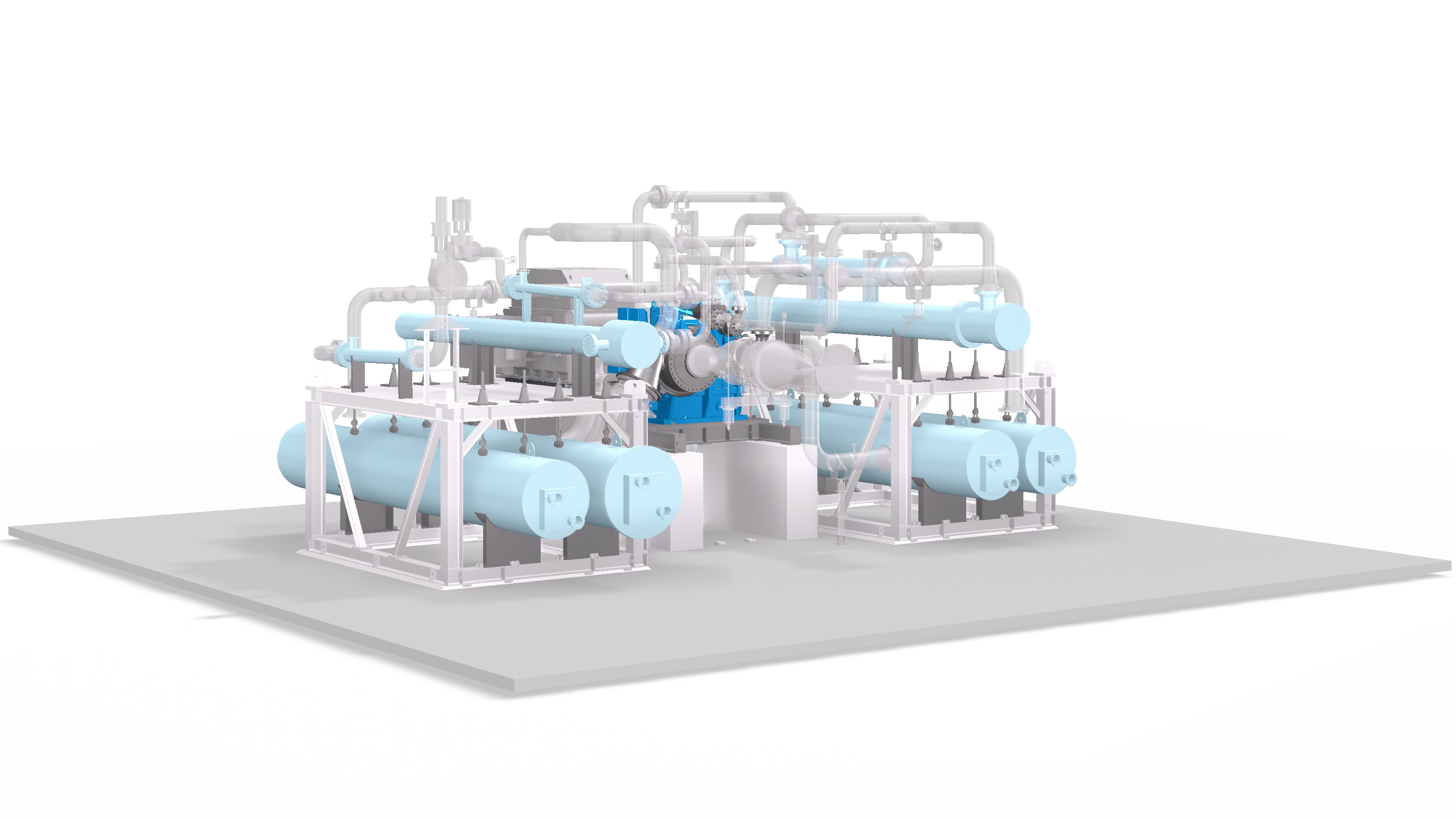
Carbon capture, utilization, and storage (CCUS) provides a proven and practical way of reducing emissions for large industrial plants. Everllence technology plays a key part in CCUS.
.jpg?sfvrsn=839615c3_3 "heidelberg-cement (1)")
Integrally geared compressors are used in industrial gases, oil and gas, CO2, urea, purified terephthalic acid or nitric acid processes. They can also be used as fuel gas boosters for large-scale gas turbines.
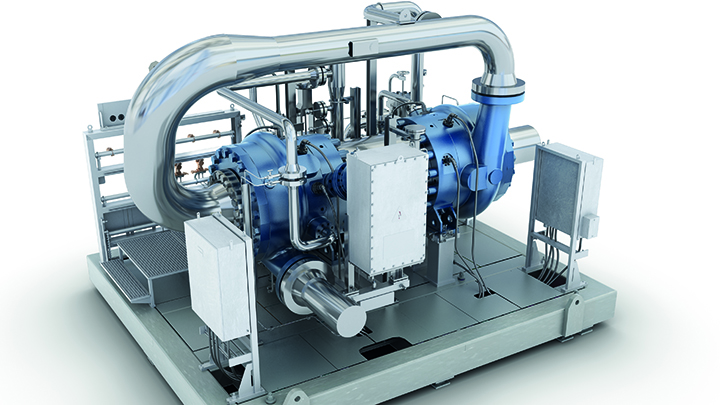
Compressors manufactured by Everllence is at the heart of many processes in various process industries. They are renowned worldwide for their quality as well as their high efficiency.
FAQ
Frequently asked questions
Carbon dioxide must be compressed to be fit for transport. Everllence uses a gas compressor to reach the desired pressure.
Carbon sequestration is the process of removing CO2 from the atmosphere and storing it.
We work closely with EPC partners and can provide turnkey compression packages, including engineering, manufacturing, installation supervision, and commissioning.
The CO2 can be captured after combustion using methods such as amine treatment, cryogenic capture or pressure swing adsorption. Most-commonly it is captured by amine absorption. The CO2 is removed by a chemical absorption process that involves exposing a flue gas stream to an aqueous amine solution. CO2 reacts with the amines to form a soluble carbonate salt. This reaction is reversible and the CO2 can be released by heating the solution with the carbonate salt in a separate stripping column. The pure CO2 is then compressed and transported to a storage site.
In many cases, the captured CO2 can serve a new purpose in other industries. For example, CO2 is needed at industrial sites making fertilizers, plastics and rubber; and it has numerous applications throughout the food and beverage industry, and in the medical industry. The purified CO2 can be transported to those facilities that utilize CO2 as feedstock.
CO2 can also be used to enrich greenhouse air to increase plant yields. Installations that traditionally emit large amounts of carbon dioxide are candidates for CCS technology, either retrofitted or as part of new plant construction. There are currently 27 large-scale CCS projects operating around the world, with many more expected.
Carbon capture and storage (CCS) is the process of capturing CO2, typically from an industrial source, either before it is released into the atmosphere or after release, via direct air capture (DAC). The captured CO2 is compressed into liquid or solid form, which can then be transported to storage locations deep underground such as depleted oil fields, saline aquifers, or other porous geological formations. This process is known as sequestration.

“We have the opportunity to decarbonize industries that are crucial for the world economy. That’s why we get out of bed every morning.”
Dr. Uwe Lauber, CEO Everllence
Discover Stories
Gain deep insights into our projects
.tmb-0.webp?Culture=en&sfvrsn=b42cc391_1)
Inside cement's first carbon capture facility
Cement is one of the world's hardest-to-abate industries. In Brevik, Norway, the first commercial CCS facility for cement production is changing that, with our RG 63-7 compressor and Carbon Capture Heat Recovery (CCHR) system at its core. The plant will compress and condition 400,000 tons of CO₂ per year, captured by SLB Capturi's amine-based process.
Gas engines for the energy transition
How do you replace a coal plant during an energy transition? In Chemnitz, the local utility chose twelve of our 20V35/44G TS gas engines as the bridge to a carbon-free future. The plants run with up to 25 percent green hydrogen today and cut CO₂ emissions by 60 percent compared to coal.
.tmb-0.jpg?Culture=en&sfvrsn=20a4a64d_1)
.tmb-0.webp?Culture=en&sfvrsn=4de058ad_1)
A glimpse behind the numbers
Can a company decarbonize entire industries while cutting its own footprint? Our 2024 sustainability report puts the numbers on the table: 63 percent less CO₂ from our own production since 2018, three strategic pillars, and clear targets for the years ahead.
A trusted partner for carbon compression
Get in touch with our experts
Would you like to learn more about carbon capture and storage and which technologies best meet your needs? Our global network of dedicated engineers is happy to point out the perfect solution for you and your business. Start your change process toward carbon neutrality now and reach out to us today.
